Your Smartphone Is a Physics Lab You Carry All Day
Most students think physics lives in a textbook or a lab with carts and timers. In reality it lives in their pockets. A smartphone is one of the most physics dense objects an average person uses, and it applies multiple branches of physics every second without asking permission.
Motion Without Moving Parts
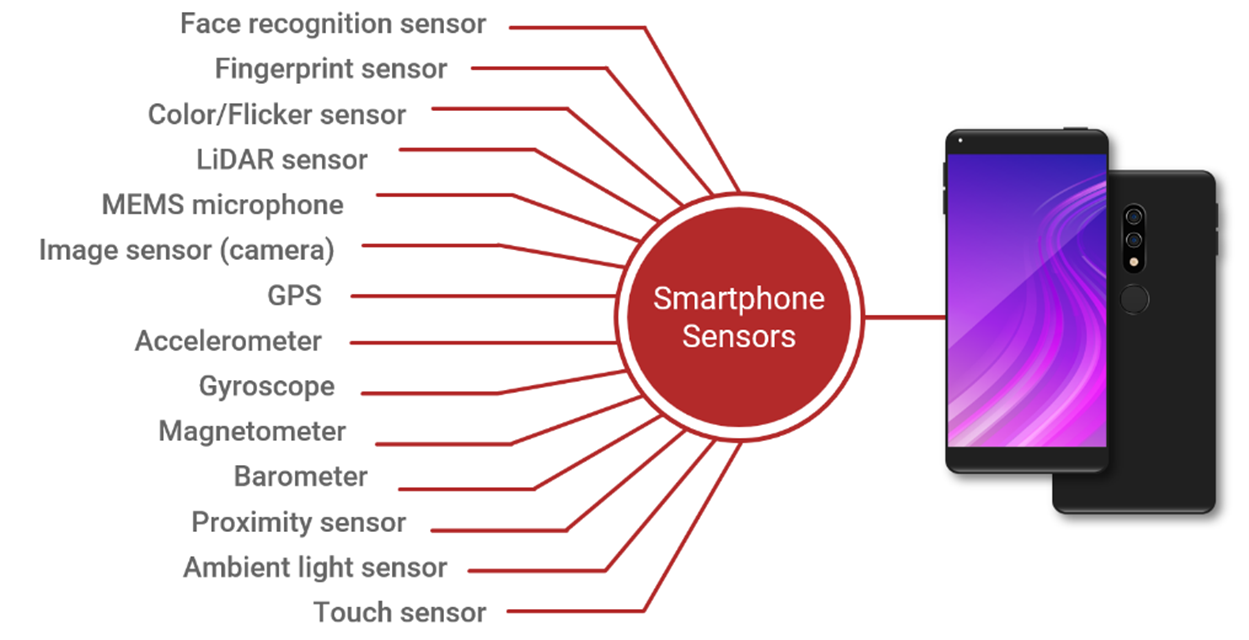
Your phone knows when you rotate it. That is not software guessing. Inside are tiny accelerometers and gyroscopes made using microelectromechanical systems. These are microscopic structures etched into silicon that physically move when the phone accelerates or rotates.
Acceleration bends these structures slightly. That bending changes electrical signals. The phone reads those changes and converts them into orientation data. This is Newton’s laws working at a microscopic scale.
No moving gears. No spinning wheels. Just mass inertia and force doing what they always do.
Touch Screens Are Electric Fields Not Magic
A touchscreen does not feel your finger. It senses how your finger disturbs an electric field.
The screen is coated with a grid of transparent conductors. An electric field exists just above the glass. When your finger approaches, it alters that field because your body conducts electricity. The phone detects the change and calculates the position.
This is electrostatics in action. The same physics behind charged balloons sticking to walls lets you send messages and scroll videos.
Light Is Doing More Than Making Pictures
The camera in your phone is an optical system that would make early physicists jealous.
Light enters through multiple lenses that bend it using refraction. The light hits a semiconductor sensor where the photoelectric effect converts photons into electrons. Each pixel counts how many electrons it receives.
The phone then applies signal processing algorithms to clean noise, adjust exposure, and fake depth of field. But the foundation is still photons carrying energy and momentum.
Even the screen works because electrons in a semiconductor emit light when excited. Quantum mechanics shows up every time the display turns on.
Sound Is Pressure Waves and Cancellation
When your phone plays music it moves air. A speaker is a coil of wire in a magnetic field. An alternating current creates changing forces that push the coil back and forth. That motion vibrates air molecules. You hear pressure waves.
Noise canceling headphones take this further. They use microphones to measure incoming sound waves, then generate inverted waves that destructively interfere. The result is silence through superposition.
That is wave physics doing exactly what the equations predict.
Location Depends on Einstein Not Just Satellites
GPS is often taught as triangulation, but that is only half the story.
Satellites carry atomic clocks that tick faster than clocks on Earth because of both special and general relativity. The difference is small but measurable. If uncorrected, your phone’s location would drift by kilometers each day.
Your map works because engineers account for time dilation predicted by Einstein. Relativity is not theoretical. It is operational.
Heat and Energy Never Take a Break
Your phone heats up during heavy use because electrical resistance converts energy into thermal motion. Batteries rely on chemical potential energy and electrochemical reactions. Conservation of energy applies relentlessly.
There is no free processing. Every app costs energy. Physics keeps the bill.
Why This Matters in the Classroom
Students often ask when they will use physics. The answer is always. They already are.
Smartphones show that physics is not a set of abstract rules but a description of how reality behaves when pushed into useful forms. Engineers did not invent new physics to build phones. They learned the rules and used them carefully.
The next time a student claims physics is pointless, ask them to turn off their phone for a day. Then ask why they want it back.